
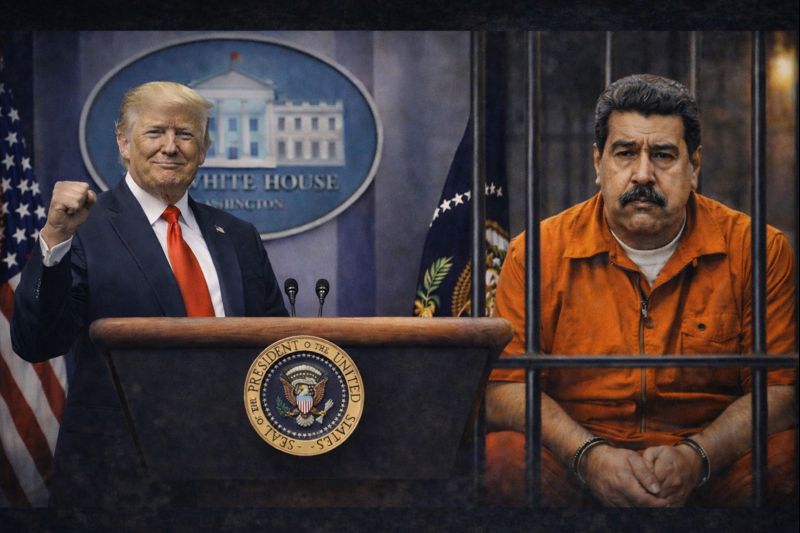
The recent U.S. action in Venezuela has sparked predictable criticism from parts of the political class and mainstream media, with familiar appeals to “international law” and accusations of “unorthodox behaviour.” Yet beneath the noise sits a far more serious reality: Venezuela under Nicolás Maduro has long been accused of operating as a narco-state, a government structure intertwined with organised crime, narcotics trafficking and international criminal networks.
The U.S. action is not an abstract diplomatic disagreement. It is about public safety, national security, and the real-world consequences of state-protected drug trafficking that directly fuels crime and overdose deaths abroad.
The Official U.S. Statement
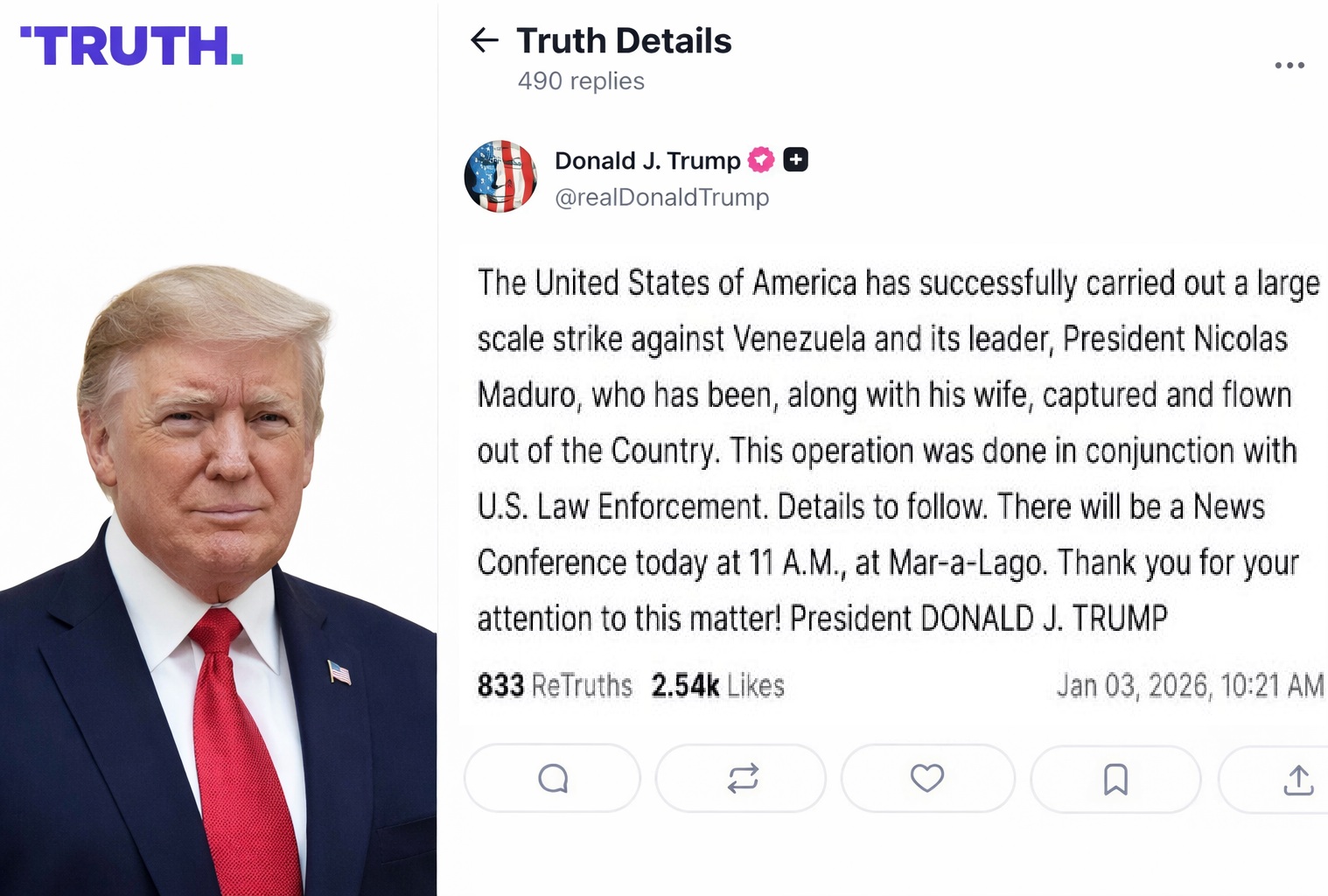
The United States confirmed the operation through a public statement issued by President Donald J. Trump on Truth Social, outlining the law-enforcement and national security framing of the action.
Administration Position
At the time of publication, no formal White House press bulletin has yet been issued beyond the President’s statement. The administration has indicated that further details will be released through official government channels.
The operation is being framed as a national security and law-enforcement matter, with emphasis on narcotics trafficking, organised crime networks and the protection of U.S. citizens.
The statement frames the operation as a response to long-standing allegations surrounding narcotics trafficking, corruption and the use of state infrastructure to protect criminal activity. This is not a conventional diplomatic dispute, it's the enforcement of criminal accountability against a regime accused of exporting organised crime beyond its borders.
The International Law Debate
Politically motivated critics have been quick to cite “international law” as a blanket objection to U.S. action. But international legal frameworks were designed to regulate relations between legitimate sovereign governments, not to provide protection for regimes accused of embedding organised crime within their own institutions.
When criminal networks are shielded by state authority and allowed to operate freely across borders, the issue moves beyond diplomacy and into the realm of transnational organised crime and national security.
Ben Habib on International Law and National Sovereignty
Advance UK leader Ben Habib has addressed this issue directly, warning that appeals to so-called “international law” are increasingly being used to undermine national sovereignty, democratic accountability and national interest.
So called international law has ever increasingly undermined national law, national interest and national democracies.
— Ben Habib (@benhabib6) January 3, 2026
Politicians pointing to international law and condemning US action have either not understood what is going on, or are against their own countries.
Ben’s words highlight a growing concern: that international legal language is being deployed as a political shield for regimes accused of criminal governance, rather than as a tool to protect democratic societies and the rule of law.
Venezuela as a Narco-State
Venezuela has been repeatedly linked to the Cartel de los Soles, a network alleged to involve senior military and political figures facilitating international drug trafficking routes. These routes have been associated with large-scale cocaine flows into North America and beyond.
This is not merely corruption. It is the fusion of political power with organised crime, a structure that exports social harm, fuels violent criminal networks, and undermines public safety in other nations.
Not to be Confused with Russia or China
Some commentators have attempted to draw comparisons between this situation and geopolitical tensions involving Russia or China. This comparison is deeply misleading.
Those states may present strategic or ideological challenges, but their leaders are not accused of operating or facilitating international narcotics cartels embedded within state structures. Narco-terrorism represents a fundamentally different category of threat; one rooted in organised crime rather than conventional geopolitics.
This Is About United States Homeland Security
When state-protected criminal networks directly contribute to addiction, organised crime and social harm abroad, national governments have both the right and responsibility to act in defence of their citizens.
This is not “geopolitical point-scoring.” It is law enforcement at an international scale, the disruption of criminal pipelines that destroy lives and destabilise societies.
Clarity Matters
Ambiguity weakens deterrence. Fence-sitting normalises criminal governance. And abstract legalism cannot be allowed to override the fundamental duty of governments to protect their people.
This moment draws a clear line: between criminal regimes that weaponise organised crime and democratic nations that refuse to tolerate it.
Later today Maduro and his wife will be arraigned in a US federal court, under US federal charges.
— Ben Habib (@benhabib6) January 5, 2026
Anyone denouncing this legitimate action on the basis it breaches the “international rules based system” and “international law” is not thinking straight.
Here’s why: pic.twitter.com/uHpS5qy0qb
Stand With Advance UK
If you agree that national sovereignty, public safety and democratic accountability must come before globalist legal abstraction, then you are not alone.
Advance UK exists to defend the interests of British citizens, promote accountable government, and challenge the erosion of national democracy by unelected international structures and agendas.
If you share these values and would like to support our work;
you can join Advance UK here.
Developing Update
In subsequent remarks following the initial announcement, President Donald J. Trump indicated that the United States would oversee a transitional period in Venezuela, describing a temporary U.S. role in managing governance arrangements until a “safe” and “proper” transfer of authority could be arranged.
At the time of publication, no formal White House press bulletin or federal administrative proclamation has been published within this article setting out the legal framework for such a transition. Readers should treat this element as developing until corroborated through official government releases and/or court documentation.
FAQ
What happened in the U.S. action in Venezuela and what was publicly claimed afterward?
Public statements circulated online (including a Truth Social post) described a major U.S. action in Venezuela and claimed the capture of President Nicolás Maduro. Readers should treat claims as developing until corroborated by formal government bulletins, court filings, or official agency releases.
Why did critics cite international law when reacting to the U.S. action in Venezuela?
Some commentators argue that cross-border action without a widely-recognised international mandate is “unorthodox” or contrary to international norms. Others counter that “international law” is often invoked selectively and can be used to restrain national decision-making even when public safety is at stake.
Why is Venezuela often described as a narco-state in relation to Cartel de los Soles allegations?
Venezuela has been repeatedly linked in public reporting and allegations to organised narcotics trafficking networks commonly referenced as the Cartel de los Soles. The narco-state argument is that state power and criminal pipelines become intertwined, exporting harm beyond national borders.
Why does Advance UK argue this Venezuela action is about homeland security rather than geopolitics?
Advance UK’s position, as articulated by Ben Habib, is that transnational narcotics pipelines and criminal governance represent a direct threat to citizens and democratic societies. Misusing international legal and political language to excuse such activity weakens law enforcement and signals to criminal regimes that their behaviour will be tolerated by the international community.
Why is comparing Venezuela to Russia or China viewed as a false equivalence in this debate?
The argument is that conventional strategic rivals are not the same category of threat as a regime accused of embedding organised crime into state structures. Narco-terrorism and cartel-linked governance are treated as criminal-national-security problems, not ordinary statecraft.
How should readers treat politicised narratives and “globalist” framing around Venezuela?
Advance UK’s view is that facts and verifiable records must come before ideology. Globalist rhetoric and politically-fashionable language should not be allowed to disguise criminal governance or distract from public safety. When elites prioritise agenda over reality, it is citizens, not politicians, who suffer the consequences.
Published: 04 Jan 2026 Author: Jim Saunders